Latest posts


May 11
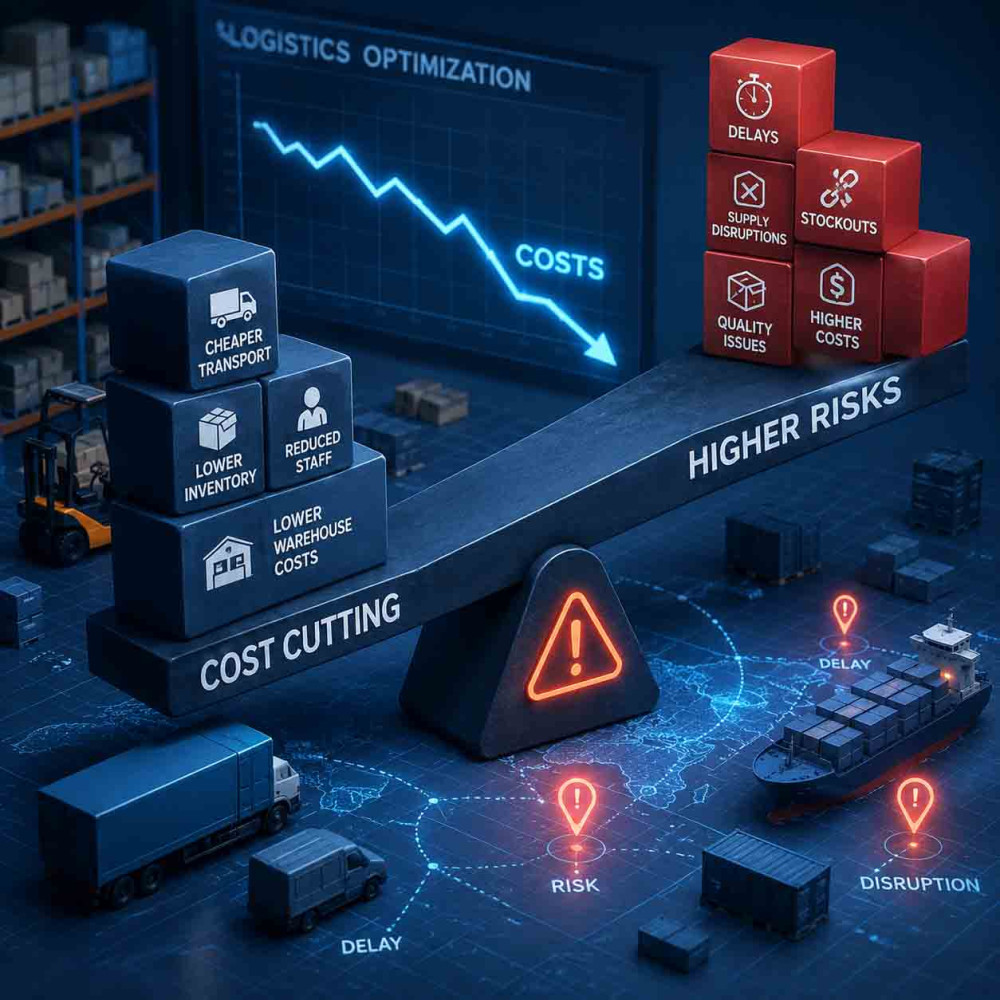
The Illusion of Optimization: Why Cost Reduction in Logistics Increases Risks
Introduction
Why are decisions aimed at reducing logistics costs increasingly producing the opposite effect — rising losses, instability, and deteriorating financial performance? Why do companies that optimize transportation, warehousing, and operations eventually face higher expenses and reduced controllability? In 2026, optimization is no longer an obvious tool for improving efficiency and is becoming a source of systemic errors.
The key problem is that logistics optimization is often viewed as a local cost-cutting measure rather than a transformation of the entire system. Companies reduce expenses at individual stages without considering the interconnections between processes. As a result, savings at one level lead to increased costs at another, creating hidden losses that are difficult to identify and even harder to eliminate.
As supply chains become more complex and variability continues to rise, logistics is no longer linear. This means that any intervention in the system must be evaluated based on its impact on the entire chain. Ignoring this principle turns optimization into an illusion that temporarily reduces costs but increases risks in the long term.
Why Classical Optimization No Longer Works
The traditional approach to optimization is based on identifying opportunities to reduce costs: choosing cheaper transportation, lowering warehousing expenses, and reducing inventory levels. In a stable environment, such measures were effective because processes were predictable and disruptions were rare.
However, in 2026, this logic no longer works. The primary reason is the growing instability and complexity of supply chains. Any decision aimed at reducing costs increases the system’s sensitivity to disruptions. In other words, savings are achieved at the expense of resilience.
Additionally, the structure of logistics is changing. Supply chains are becoming longer and more complex, increasing the number of risk points. Under these conditions, local optimization is no longer effective because it fails to account for the impact on the entire system.
As a result, classical optimization makes the system less resilient while risks become more significant. This creates the need to rethink approaches to cost management.
The Economics of Optimization: Where the Gap Emerges
The main mistake lies in the fact that companies evaluate optimization only at the level of direct costs while ignoring indirect effects. For example, reducing transportation costs may lead to longer delivery times, affecting inventory levels, turnover rates, and operational processes.
This gap between direct and indirect costs forms the main source of losses. Savings on freight rates may lead to higher warehousing, management, and disruption-related expenses. As a result, the total cost becomes higher than it would have been with a more expensive but stable solution.
It is also important to consider the impact on risks. Cost reduction is often accompanied by a higher probability of disruptions. This means that even isolated incidents can eliminate all achieved savings.
Thus, optimization without considering the full economic impact becomes a source of systemic losses.
Where the System Breaks During Cost Reduction
The most vulnerable parts of the supply chain are those that ensure stability. Cost reduction often occurs through the elimination of buffers, simplification of processes, and reduction of control mechanisms.
Key areas where problems emerge include:
• inventory reduction
• selection of cheaper routes
• lower levels of operational control
• reduction of resources
These measures make the system more efficient under stable conditions but significantly increase risks when disruptions occur.
In addition, an overload effect emerges. When resources are reduced, any additional pressure causes failures that spread throughout the entire chain. This makes the system less resilient and increases the probability of losses.
Hidden Losses: How Savings Turn Into Costs
The main losses associated with optimization are hidden in nature. They do not appear immediately but accumulate over time and become visible only in the long term.
Key mechanisms include:
• increased delivery-time variability
• growth in operational expenses
• decline in process quality
• increase in the number of errors
These factors create a cumulative effect that reduces efficiency and increases costs.
What makes these losses particularly dangerous is that they are difficult to measure. They are distributed across the entire system and are not recorded as separate events. This makes them effectively invisible from a management perspective.
The Impact of Time, Cost, and Instability
Cost reduction is often accompanied by increased lead times and greater variability. This is because cheaper solutions are usually less stable and require more time.
The key issue is that higher variability affects the entire supply chain. Companies are forced to adapt processes, increase inventory levels, and build additional buffers, all of which raise costs.
Moreover, instability amplifies the impact of external factors. Any disruption triggers a chain reaction that increases losses across the system.
As a result, lower costs become a factor that increases overall complexity and reduces efficiency.
Business Mistakes in Optimization
One of the key mistakes is the local approach. Companies optimize individual elements without considering the impact on the overall system. This leads to unbalanced decisions.
Another common mistake is focusing on short-term effects. Savings are achieved quickly but are accompanied by long-term losses.
A further major issue is the lack of data transparency. Without visibility, it is impossible to evaluate the real impact of optimization, which increases the likelihood of mistakes.
How the Approach to Cost Management Is Changing
In 2026, companies are shifting from optimization to efficiency management. This means that decisions are made with consideration for their impact on the entire system.
Balance becomes the key priority. Companies must consider not only costs but also risks in order to make informed decisions.
At the same time, the role of analytics is increasing. Companies are using data to evaluate and manage processes more effectively, improving operational performance.
Where the Boundary of Efficiency Lies
In logistics in 2026, the boundary of efficiency is no longer located where costs are minimized but where the system stops being able to absorb disruptions. This is a fundamental departure from the classical model in which efficiency was measured through lower operating costs. Today, the key parameter is the ability of the supply chain to remain manageable under unstable conditions.
Every cost-reduction decision effectively shifts this boundary. Lower inventory levels reduce financial pressure but simultaneously remove buffers from the system. Cheaper transportation lowers direct expenses but increases delivery variability. Warehouse optimization reduces costs but weakens the ability to handle demand peaks. Once the number of such decisions reaches a critical mass, the system loses resilience, and even minor disruptions begin to produce disproportionate consequences.
In practice, this means logistics starts operating “at the limit.” Any delay, disruption, or change in conditions triggers a chain reaction: deadlines are missed, inventory levels rise, workloads increase, and unexpected expenses appear. At the same time, the decisions that caused the situation still appear economically justified when analyzed in isolation. The problem emerges specifically at the system level.
Thus, the boundary of efficiency is the point at which further cost reduction stops generating economic value and begins generating risks whose cost exceeds the achieved savings. This boundary is always individual and depends on the structure of the supply chain, the level of variability, and the company’s ability to manage disruptions.
Companies operating below this boundary are forced to constantly compensate for instability through additional resources, making their model implicitly expensive. Companies operating above this boundary deliberately preserve redundancy within the system — in the form of buffers, reserves, and more stable solutions — thereby ensuring predictability and controllability. This becomes the new form of efficiency, where profit is generated not through minimal costs but through control over risks.
Emerging Trends: Resilience Instead of Minimum Cost
One of the key trends is the shift in focus from cost minimization to resilience. Companies are beginning to understand that stability is more important than the lowest possible cost.
This is changing management approaches, where the priority is no longer only cost reduction but also risk management.
At the same time, flexibility is becoming increasingly important and is turning into a key competitive factor.
Conclusion: Optimization as a Source of Risk
The key conclusion is that in 2026, logistics optimization is no longer a universal tool for improving efficiency and is becoming a potential source of risk. Cost reduction without considering systemic interdependencies causes logistics systems to lose resilience while businesses lose control over processes.
The fundamental shift is that efficiency is no longer defined by minimal costs. It is defined by the system’s ability to operate consistently under disruptive conditions. This requires a transition from local decisions to managing the entire supply chain as a unified system.
Companies that understand this transformation begin to view optimization as a controlled process rather than an end goal. They evaluate every decision based on its impact on resilience and risk, allowing them to maintain a balance between costs and efficiency.
Meanwhile, companies that continue focusing exclusively on cost reduction increasingly discover that achieved savings turn into growing hidden expenses. As a result, optimization transforms from a tool for improvement into a factor that systematically increases losses and reduces business profitability.
Your experience matters! Take a short survey and see how others answered. Take part