Latest posts


Feb 27
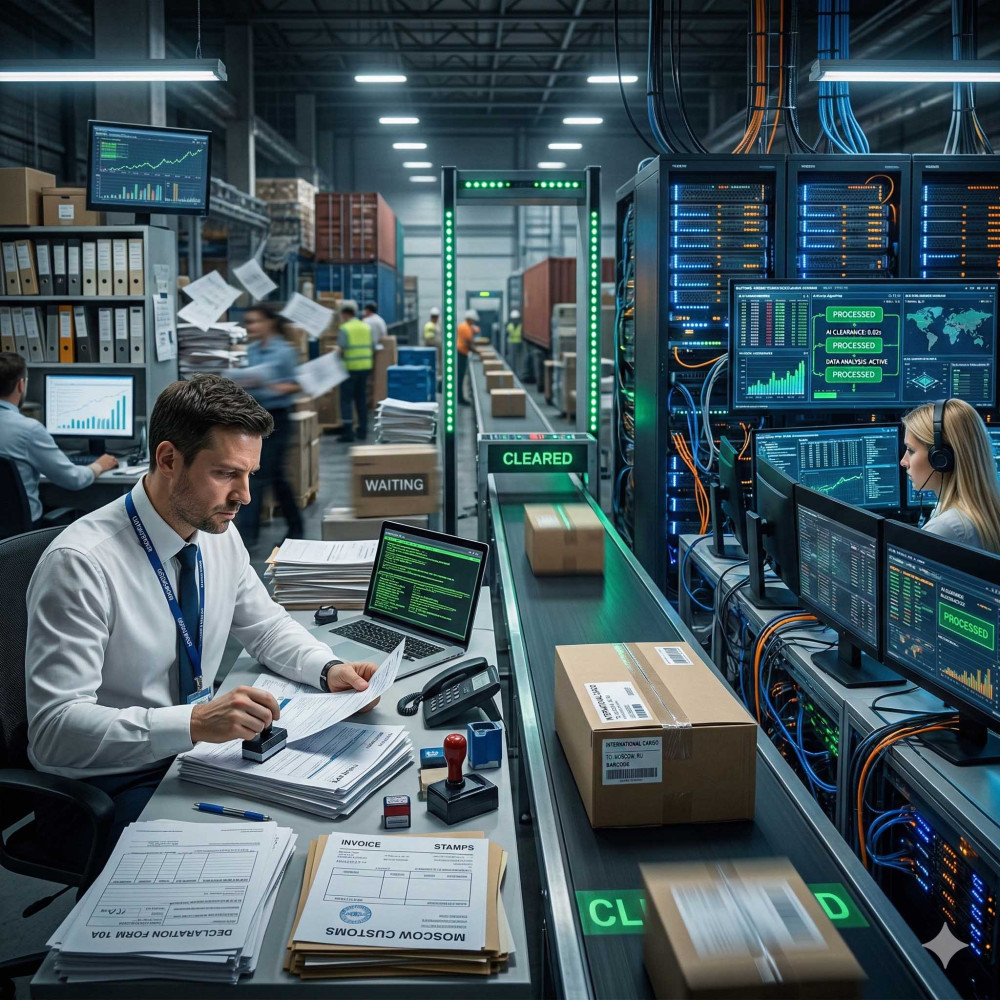
Customs: who's faster—a human broker or a neural network?
Customs as a supply chain bottleneck
Even the most perfectly planned logistics can stall at one stage – customs clearance. For businesses, this is a critical point: an error in the declaration, an incorrect HS code, or document discrepancies can turn a fast delivery into a week-long delay, vehicle downtime, and additional costs.
By 2026, customs remains one of the most sensitive stages of international trade, but the process itself is rapidly changing. Electronic declarations, automated checks, and integration with government systems have made customs clearance more digital. At the same time, a new player has emerged in the process: artificial intelligence systems that analyze data, assist in document preparation, and predict inspection risks.
As a result, businesses face a practical question: who is more effective today – an experienced broker or an algorithm?
How a human broker works
A customs broker traditionally relies on knowledge of the law, practical experience interacting with inspectors, and experience from previous deliveries. They are able to consider not only formal requirements but also subtle nuances:
• classification specifics of specific goods
• clearance practices at a particular border crossing
• typical causes of delays
• requirements for accompanying documents
• potential questions from inspectors
The human factor plays a crucial role here. The broker can spot an unusual situation, ask the client clarifying questions, or adjust the documents in advance to avoid problems.
This flexibility is especially important for complex deliveries, when the cargo is not entirely standard or the chain involves several countries and customs regimes.
How neural networks work in customs clearance
AI systems operate differently. They analyze large data sets: past declarations, product classifications, tariffs, regulatory requirements, and inspection history. Based on this, algorithms can:
• automatically fill out declarations
• suggest TN VED codes
• check document completeness
• identify potential errors
• assess the likelihood of inspection
• speed up document preparation
The main advantage of neural networks is speed and scale. What would take a human being hours, a system can complete in minutes, especially when dealing with recurring shipments.
Furthermore, the algorithm doesn't tire and prevents accidental typos, reducing the incidence of technical errors.
Why speed isn't the only criterion
At first glance, it seems that the neural network clearly wins. However, in customs clearance, it's not just the speed of document completion that matters, but also legal correctness and risk management.
The algorithm works well where the data is structured and the situation is typical. However, difficulties arise when:
• the goods are new or combined
• the documentation is in a non-standard format
• there are controversial classification issues
• clarification from the inspection is required
• rules or application practices change
In such cases, an experienced broker can assess the situation more broadly than the algorithm and offer a solution that will reduce the risk of delays.
How the market has changed by 2026
In recent years, customs clearance has gradually shifted from manual processing to a hybrid model. More and more companies are using AI tools to prepare documents, but they're still relying on brokers.
In practice, a new model is emerging:
• a neural network processes the data and prepares the declaration
• the system checks for errors and discrepancies
• the broker analyzes the results
• a human makes the final decision and bears responsibility
This approach simultaneously speeds up the process and maintains control.
The economics of automation
The introduction of AI in customs clearance impacts not only speed but also the economics of logistics.
Reducing errors reduces the likelihood of:
• border delays
• fines for incorrect declarations
• additional inspections
• storage and downtime costs
Furthermore, automation allows for the processing of larger shipment volumes without a proportional increase in staff.
However, fully automated solutions require investment and setup, so they are not yet always feasible for small businesses.
How the broker's role is changing
With advances in technology, the broker's role is gradually evolving. While previously largely focused on filling out paperwork, their responsibilities are now shifting toward:
• analyzing complex situations
• handling non-standard cargo
• consulting on classification and regimes
• interacting with customs authorities
• managing risks and liability
The broker is becoming not a data processor, but a decision-making expert.
Who's faster in practice?
If we consider only the technical preparation of the declaration, a neural network is almost always faster.
If we consider the entire registration process, including verification, communication, and resolving non-standard issues, the hybrid model often has the advantage.
In standard shipments, automation can significantly speed up the process.
In complex shipments, human experience remains the key factor.
The future of customs clearance
In the coming years, artificial intelligence will likely become a standard tool in customs processes. Government systems are already transitioning to digital checks, and international trade is moving toward more complete automation of documents.
However, a complete replacement of humans is unlikely. Customs remains an area where law enforcement, interpretation of regulations, and interaction with inspectors play a crucial role.
Therefore, the future of customs clearance is not a competition between humans and machines, but a collaboration between them.
Bottom Line
Artificial intelligence does indeed speed up customs clearance and reduce technical errors. But broker expertise remains critical for complex shipments and risk management.
In 2026, the winner will not be the one who chooses only humans or only technology, but the one who builds a system where automation increases speed and an expert ensures correctness and accountability.
Your experience matters! Take a short survey and see how others answered. Take part